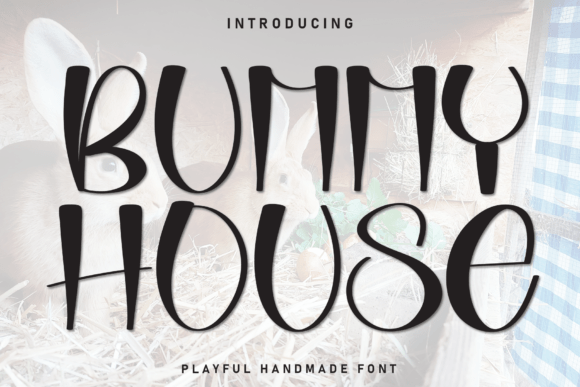
Bunny House Typeface: A Friendly Display Font for Approachable Branding
I was staring at a blank Figma file, trying to crack the visual code for a new local bakery’s rebrand. The client wanted warmth without being childish, and professionalism without feeling stiff. That’s when I pulled up Bunny House, a casual and neat display font that combines simplicity with a friendly, approachable vibe. It felt like an immediate solution. Featuring clean lines, balanced letterforms, and subtle rounded edges, it captures the essence of modern, inviting design in a way that few other typefaces manage to do so effortlessly.
As a brand designer, I don’t just look at glyphs; I look at how they behave in the wild. I tested this font across a full identity system—from a logo draft and business card to a website header and social media layout. Here is my honest review of how Bunny House performs as a commercial tool for designers and entrepreneurs.
Bunny House for Bakery Packaging and Food Brand Identity
When you are designing packaging for food products, the typography needs to feel edible—inviting, soft, and trustworthy. Bunny House excels in this niche because its rounded edges mimic the tactile nature of baked goods and fresh ingredients. In my test project, I used the primary weight for the main product name on a jar label. The result was striking; the font didn’t scream for attention but rather welcomed the customer in.
This typeface works particularly well for brands that want to communicate artisanal quality or homemade charm. Unlike overly decorative script fonts that can become illegible at small sizes, Bunny House maintains high readability while retaining personality. Its neat structure ensures that essential information, like ingredients or net weight, remains clear when paired with smaller body text. For handmade sellers, online shop owners, and crafters, using a creative font like this helps establish a distinct visual hierarchy that stands out on crowded digital shelves.
Bunny House Logo Design and Business Card Applications
A logo needs to be scalable, memorable, and versatile. Testing Bunny House in a logo context revealed its strength in short phrases and wordmarks. Because it is a display font, it commands space effectively. I placed the font on a minimalist business card mockup, pairing it with ample white space and a soft pastel background. The balanced letterforms provided a sense of stability and reliability, which is crucial for building brand trust.
However, there are limitations to keep in mind. While Bunny House is fantastic for headlines and logos, it is not designed for long body text. Using it for paragraphs would create visual fatigue due to its stylized nature. Instead, treat it as a headline font or an accent font. For supporting text, pair it with a neutral sans serif font or a classic serif font to create contrast. This combination allows the brand identity to remain cohesive while ensuring that detailed information is easy to read. When reviewing included styles, check if the package offers multiple weights; having access to bold and regular variants gives you more flexibility in your modern typography systems.
Bunny House Social Media Graphics and Web Headers
In the realm of digital marketing, first impressions happen in milliseconds. Bunny House is perfectly suited for Instagram posts, Pinterest pins, and website hero sections where large text dominates the viewport. The friendly, approachable vibe of the font aligns perfectly with content creators who want to engage their audience without appearing corporate or distant.
I created a series of social media graphics promoting a weekend sale, using Bunny House for the promotional text. The subtle rounded edges softened the message, making the call-to-action feel like a suggestion from a friend rather than a demand. For web design, this font can serve as an excellent H1 or H2 tag, drawing the eye immediately. Just ensure that the contrast between the font color and the background is sufficient to maintain accessibility standards. If you are building a brand identity for a creative studio, boutique, or café, incorporating this font into your digital assets creates a consistent and recognizable voice across all platforms.
Bunny House Editorial Design and Print Collateral
While primarily a digital-friendly display font, Bunny House also translates beautifully to print. I tested it on a flyer for a local art workshop and found that the clean lines reproduced sharply on standard office printers as well as professional offset presses. The font’s aesthetic works well for editorial design projects such as zines, event programs, or limited-edition book covers.
For those looking to expand their design assets, consider how Bunny House can complement other typefaces. It pairs naturally with handwritten fonts for a personal touch or with geometric sans serif fonts for a contemporary look. Before finalizing any client work, it is wise to print a physical proof. Seeing the font in three dimensions helps you judge how the rounded edges interact with paper texture and ink absorption. This step is often overlooked but is critical for ensuring that the final product matches your vision.
Technical Considerations and Licensing for Commercial Use
Before downloading or purchasing any premium font, always review the technical specifications. Check the file formats available (usually TTF, OTF, and sometimes WOFF2 for web use) and verify multilingual support if your brand operates internationally. Ensure that the license covers your intended use case, whether it is for a single logo, a full brand identity, merchandise, or templates sold to others.
Commercial font licensing varies significantly. Some licenses allow unlimited usage for a specific project, while others require separate rights for different mediums. As a freelancer or agency owner, protecting yourself means reading the fine print. Bunny House appears to be designed with the modern creator in mind, offering versatility that justifies its investment. By choosing a reliable, well-crafted typeface, you reduce the risk of legal issues and elevate the perceived value of your design work.
Ultimately, Bunny House is more than just a set of characters; it is a mood setter. It brings a sense of calm and approachability to any design project. Whether you are refreshing a skincare product brand, launching a new blog, or creating a visual identity for a local restaurant, this font provides a solid foundation for effective communication. Test it thoroughly, pair it wisely, and let its friendly character do the heavy lifting in your next branding endeavor.